- Edition
- Third
- Date
- March 2024
- Venue
- Kothari Hall, Bangalore
- Running time
- 1:17:00
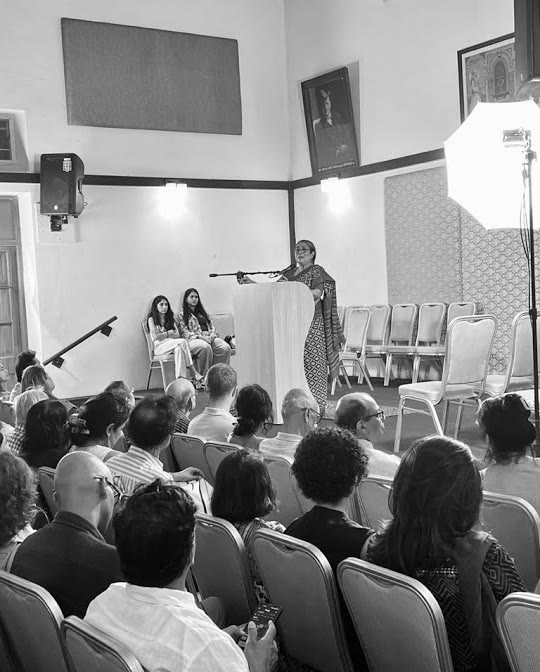
Recorded live at Kothari HallWatch on YouTube ↗
The lecture
Arundhati Nag came to Bangalore in 1979 “for love”. She was an actor who had sometimes played 42 shows a month in Bombay. In Bangalore she found one government auditorium, available perhaps four nights a year, and no Hindi, Gujarati or Marathi stage at all. In the third lecture she told how the city’s theatre grew from that scarcity: plays in a Malleswaram hall lit by lamps set in Dalda tins, the long tradition of Kannada and English amateur theatre, and Ranga Shankara. That theatre, dreamt of with Shankar Nag and built after his death with four crores raised from the people of Bangalore, still charges ₹2,500 a show twenty years on. Speaking as a fellow migrant, she paid tribute to Ravi Sondhi. She called theatre a country of its own, and asked the city to build many more affordable stages.
In six movements
What was said
A migrant for love
She opened with Ravi Sondhi and the Partition migrants of Chiranjiv Singh’s lecture, and named the largest migration of all: women leaving home for marriage. She married Shankar Nag on 9 November, two days after he proposed. Within weeks she had a new language, a new kitchen and a new window to wake up to.
From 42 shows to four
Ravindra Kalakshetra gave a group one date every three months. So the Nags hired the Gokhale Institute hall in Malleswaram, sold cheap tickets for folding chairs, and lit the stage with bulbs set inside Dalda tins.
A city of amateurs
Bangalore’s theatre runs on passion, not pay. Its actors are restaurateurs, coffee planters and consultants by day. She traced how BLT trained generations of English actors, and how Gubbi Veeranna, Kailasam and the playwrights who followed turned Kannada theatre into a statewide movement.
The building of Ranga Shankara
The idea began with Shankar and was realised after his death, when BLT generously stepped back from a civic-amenity site. “We lost a good actress and got a bad administrator,” Girish Karnad teased. Every rupee of the four-crore outlay came from Bangaloreans.
The affordable stage
Rent was set at ₹2,500, enough to cover the electricity, with lights and air-conditioning included. It has never been raised. That is why Ranga Shankara stages some 400 shows a year and why the city’s theatre groups have doubled from 44 to 88. She called it a model every town deserves.
Theatre as a country
Bangalore now has some 31 theatre spaces. She called for smaller stages in every direction of the city and for young audiences, and argued that theatre should be the petri dish for stories that cinema and television cannot afford to tell.
In their words
“I am a migrant too… the largest migrations on this planet are through marriage. I came here for love.”
“We wanted a theatre for theatre — for amateurs who were not earning money from it, but were passionate about it.”
“I had no idea I was building an institution. I just thought I was building a theatre.”
The speaker
Arundhati Nag is an actor and theatre-maker whose stage career began in Bombay’s Marathi, Gujarati and Hindi theatre. She came to Bangalore in 1979 after marrying Shankar Nag. She is the founder and managing trustee of Ranga Shankara, which opened in 2004 in Shankar Nag’s memory and has hosted more than 7,000 performances in over 20 languages. Her honours include the Padma Shri, the Sangeet Natak Akademi Award and the National Film Award for Best Supporting Actress for Paa. Girish Karnad, her mentor, wrote Bikhre Bimb for her.