- Edition
- Fourth
- Date
- February 2025
- Venue
- Kothari Hall, Bangalore
- Running time
- 1:53:54
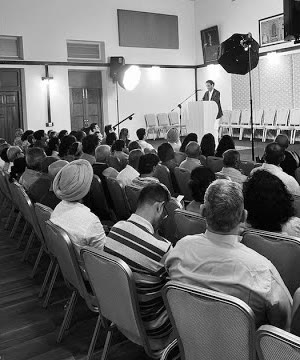
Recorded live at Kothari HallWatch on YouTube ↗
The lecture
Long before Bangalore was a byword for software, it was a city of playing grounds and gymkhanas, garadi manes and boxing rings. In the fourth lecture, the journalist Stanley Carvalho traced that forgotten inheritance. It began in the missionary schools and Cantonment clubs of the 1800s and ran through barefoot Olympians, a golden age of women’s hockey, and a line of sprinters who for decades made “the fastest woman in India” a Bangalore girl. There were prize fights at the Opera House and a “mini-Brazil” in Goutampura. A mother and daughter partnered each other at the national badminton championships, and athletes cycled to Kanteerava at five in the morning. It was a fitting subject for a lecture named after Ravi Sondhi of Hat-trick Sports, whose first love was cricket.
In six movements
What was said
Schools and the Cantonment
Sport took root after the British moved the Cantonment to Bangalore and the missionary schools followed: St Joseph’s in 1858, Bishop Cotton in 1865, Cathedral in 1866. Compulsory PT, good grounds and inter-school meets seeded a sporting culture.
Golf, boxing and polo
The Bangalore Golf Club dates from 1876. In 1943 a newspaper doubted that any other Indian city kept boxing “to such a high pitch as in Bangalore.” The city’s boxers included Gunboat Jack and “Tokyo” Ranganathan.
Cricket
B. Jayaram played alongside W.G. Grace for London County in 1903. The roll continues with M. Chinnaswamy, Shantha Rangaswamy and the clubs of Bangalore, Friends Union among them, which Ravi Sondhi served for decades.
Hockey and football
Bangaloreans played at the Olympics from Helsinki in 1952 onward. Karnataka’s women were unbeaten from 1961 to 1967. Seven of India’s barefoot footballers at the 1948 London Olympics came from the city.
Courts and tables
Dechu Appaiah became national tennis champion. Prakash Padukone’s All England title began in a Canara Union hall that his father had enlarged. Tripura Vishwanath played the national badminton doubles with her own daughter.
Why Bangalore?
Carvalho credited the mild climate, the schools, the public-sector companies and banks that gave athletes jobs, and the late arrival of television. He also credited the patrons and sports shops: Rakra, Arun, Olympic “and of course Hattrick.”
In their words
“You can get out of Bangalore, but you can never get the Bangalore out of you.”
“How did Bangalore — a sleepy pensioners’ paradise — spawn so many national and international sporting champions?”
“These stories underline the endurance of not only the human spirit but also the spirit of Bangalore.”
The speaker
Stanley Carvalho is a Bangalore-born journalist and writer. He spent 25 years in full-time reporting, including a decade in the UAE and fourteen years with Reuters, and now writes for Deccan Herald and The Hindu. He trains journalists with the Reuters Foundation and teaches at Alliance University. He has written and edited three books on the city, among them Bangalore Blue and Past and Curious.